Special thanks to Johannes Fröhlich and the digital marketing agency Dreifive for their joint contribution to this blog article.
Page speed has been a decisive ranking factor at the latest since June 2021, when Core Web Vitals were integrated into Google’s algorithm. It can be critical when it comes to getting your website displayed as high as possible in search results. Google even goes one step further and states: the faster the website, the more conversions. Hmm…
Now imagine the following scenario. You are standing in the middle of your favorite big city and spontaneously looking for a burger restaurant because you have just run into an old friend. You are using the latest iPhone with a perfect 5G connection.
You are hungry. The competition is even hungrier. There is a burger place on every corner. Distractions are everywhere. Your friend is chatting away, traffic noise surrounds you… Now every second counts, and page load time can truly become the decisive conversion driver for that burger restaurant.
But even with a poor smartphone and an even worse internet connection, the desired information should be found quickly. That is Google’s goal. So yes, page load time can be crucial when it comes to whether customers find YOUR brand, trust YOUR business, and ultimately buy from YOU. No matter what you prioritize in 2022, whether revenue growth, customer retention, or international scaling, everything depends on the performance of YOUR website.
Before diving deeper, here is a brief explanation of the Core Web Vitals.
The Core Web Vitals in brief
Core Web Vitals are Google’s new core metrics which, together with other signals, form the ranking factor “Page Experience”.

The Core Web Vitals consist of three KPIs used to evaluate website usability:
Speed: Largest Contentful Paint (LCP)
Interactivity: First Input Delay (FID)
Stability: Cumulative Layout Shift (CLS)
Important: Google continuously evaluates and adjusts the Core Web Vitals based on technical requirements and user behavior. Changes to these metrics are therefore possible.
Let’s briefly take a closer look at each key metric.
Largest Contentful Paint: how fast does the website load?
In short, Largest Contentful Paint (LCP) measures the loading time until the largest content element (images, videos, text blocks) within the visible area of the website has loaded.
Google defines the following thresholds:
Good: up to 2.5 seconds
Needs improvement: 2.5 to 4 seconds
Poor: over 4 seconds
Which element is considered the largest depends on the loading process. In most cases, the largest element is loaded last. Below is an example from the JENTIS website.

You can find all details and the exact calculation methodology in Google’s documentation on Largest Contentful Paint.
First Input Delay: when can users interact with the website?
In short, First Input Delay (FID) measures the time between a user’s first interaction with a website and the browser’s response.
When visiting a website, users may click on a button before the page has fully loaded. At that moment, the browser often does not respond because it is still busy loading the page. To prevent users from bouncing, FID measures how much delay occurs between the user’s input and the browser’s reaction. The main factor here is the “Time to Interactive”.
Google defines the following thresholds:
Good: up to 100 ms
Needs improvement: 100 to 300 ms
Poor: over 300 ms
More details about FID can be found in Google’s documentation on First Input Delay.
Cumulative Layout Shift: how stable is the website?
In short, Cumulative Layout Shift (CLS) indicates whether and to what extent unexpected layout shifts occur while users interact with your website.
Unexpected layout shifts happen when elements move during the loading process, for example when content is pushed down because other elements are loaded later. This can lead to a poor user experience.
Google defines the following thresholds:
Good: 0.1
Needs improvement: 0.1 to 0.25
Poor: over 0.25
All details and the calculation methodology can be found in Google’s documentation on Cumulative Layout Shift.
This concludes the definition of the Core Web Vitals (LCP, FID, CLS).
Moving into practice
How to check the Core Web Vitals
You can evaluate your website’s performance using Google Lighthouse, Google Search Console, or directly via Google PageSpeed Insights. Simply enter your domain into the input field and click “Analyze”.
After a few seconds, you will see whether your website passes the Core Web Vitals assessment or not.
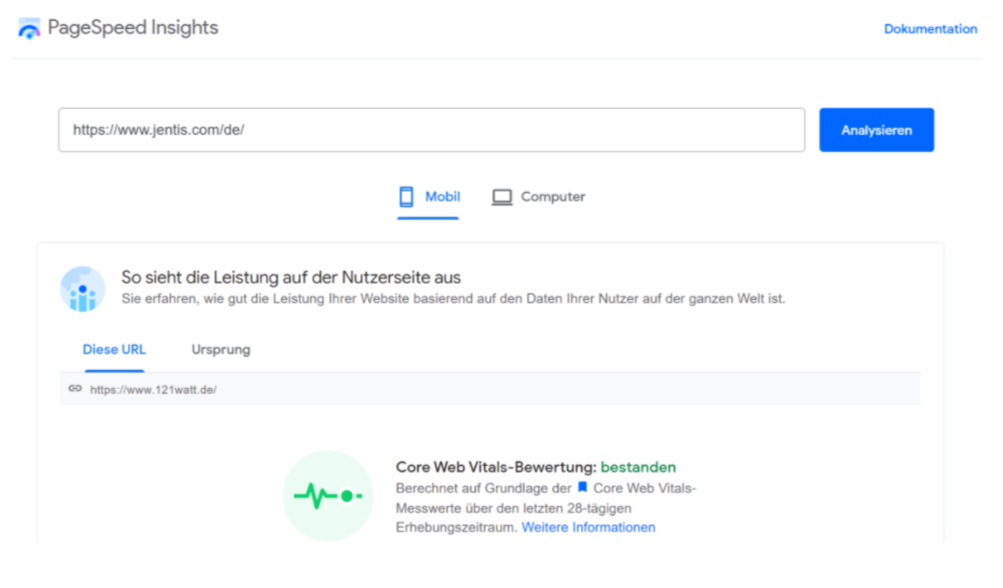
You will also receive a speed score for mobile and a speed score for desktop. The score ranges from 0 to 100, where 90–100 is good, 50–80 needs improvement, and below 49 is poor.
Tip: Since Google has indexed websites using a “mobile first” approach since March 2021, it is crucial that the mobile speed score is strong. If mobile performance is optimized, desktop performance usually follows automatically.

Below the overall score, the Core Web Vitals results are displayed as both field data and lab data. Field data consists of anonymized data from real users on different devices and network connections. Lab data is simulated data based on a single device and a predefined network setup.

Depending on the results, Google provides a list of recommendations under the Core Web Vitals section, along with an estimate of how many seconds the page load time could be reduced.

Where are the biggest optimization levers?
Every recommendation from Google represents a potential optimization lever. However, as always, costs and benefits must be weighed against each other. Google still values high-quality content above all else. Before investing countless hours to make your website 100 milliseconds faster, it may be more effective to invest that time in creating valuable, user-friendly content.
Links: DreiFive | Doku Largest Contentful Paint | Doku zum First Input Delay | Doku Cumulative Layout Shift | Google PageSpeed Insights