Persistent Cookies & IDs
Recognize your users across sessions and domains.
JENTIS Cookie Lifetime Extender sets its cookies from your own domain. Browsers keep them for up to two years, ad-blocker lists do not block them, and one ID follows a user across all your subdomains.
Book a demoSafari and Firefox
Prevent Safari from deleting cookies you depend on.
Safari and Firefox delete first-party cookies set by other tracking tools after seven days. A user who returns on day 8 is counted as new. Firefox applies similar rules.
Using JENTIS Cookie Lifetime Extender, cookies stay presistent in Safari browsers. The user ID keeps its full lifetime of up to two years, so returning Safari users stay recognizable.
Ad blockers
Make your cookies adblocker-proof.
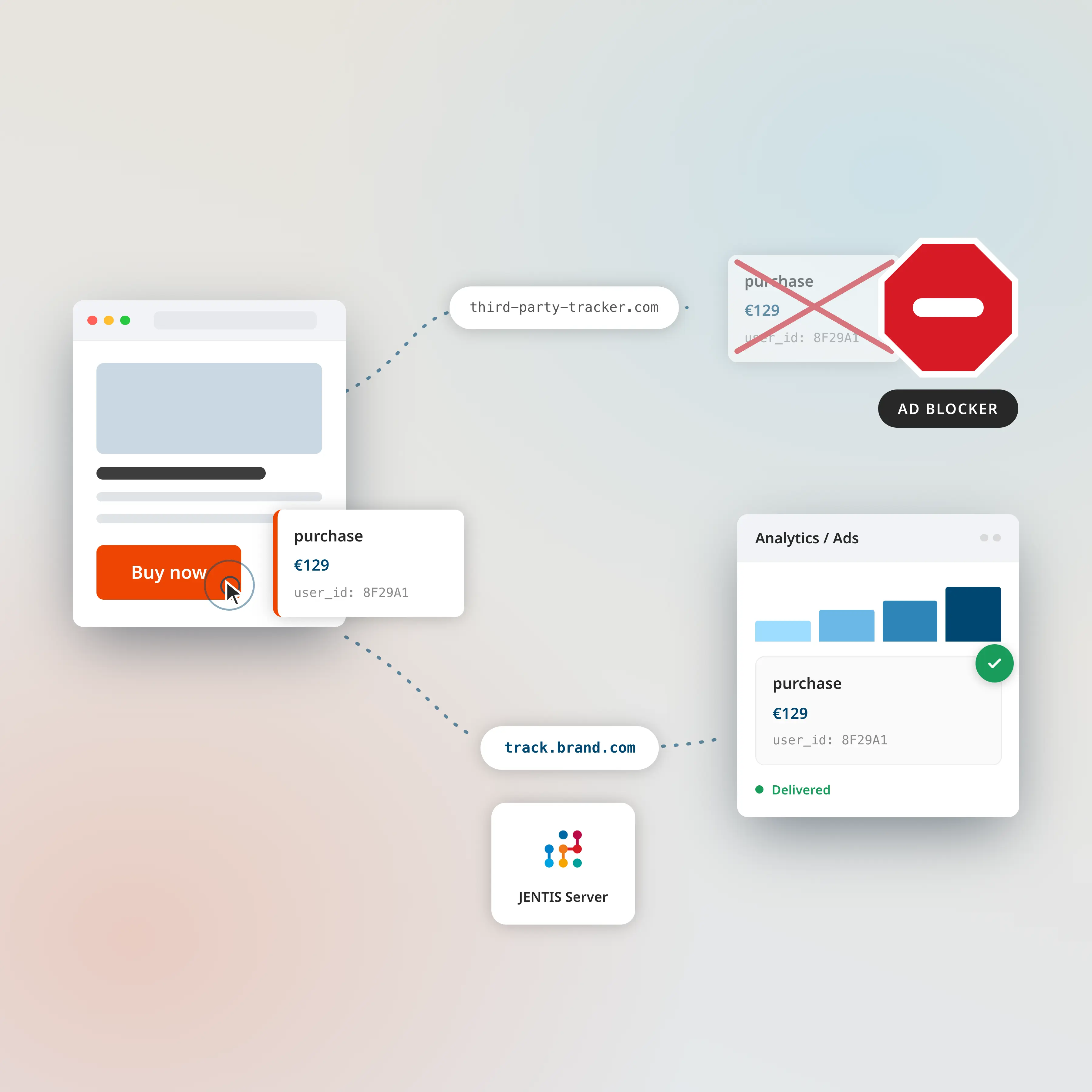
Ad blockers stop requests to known tracking domains. No cookie is set, no data is sent.
JENTIS runs on your own domain, which is not on those lists. The cookie is set, the data arrives, and you decide which tools receive it.
Main Domain Cookie
One ID across your main domain and all subdomains.
If shop, login and content run on separate subdomains with separate cookies, one person looks like three visitors.
The JENTIS user ID is set on your main domain and read by every subdomain. One setting in the container, one ID per user across all of them.
Connected tools
Upgrade your entire tech stack with persistent IDs.
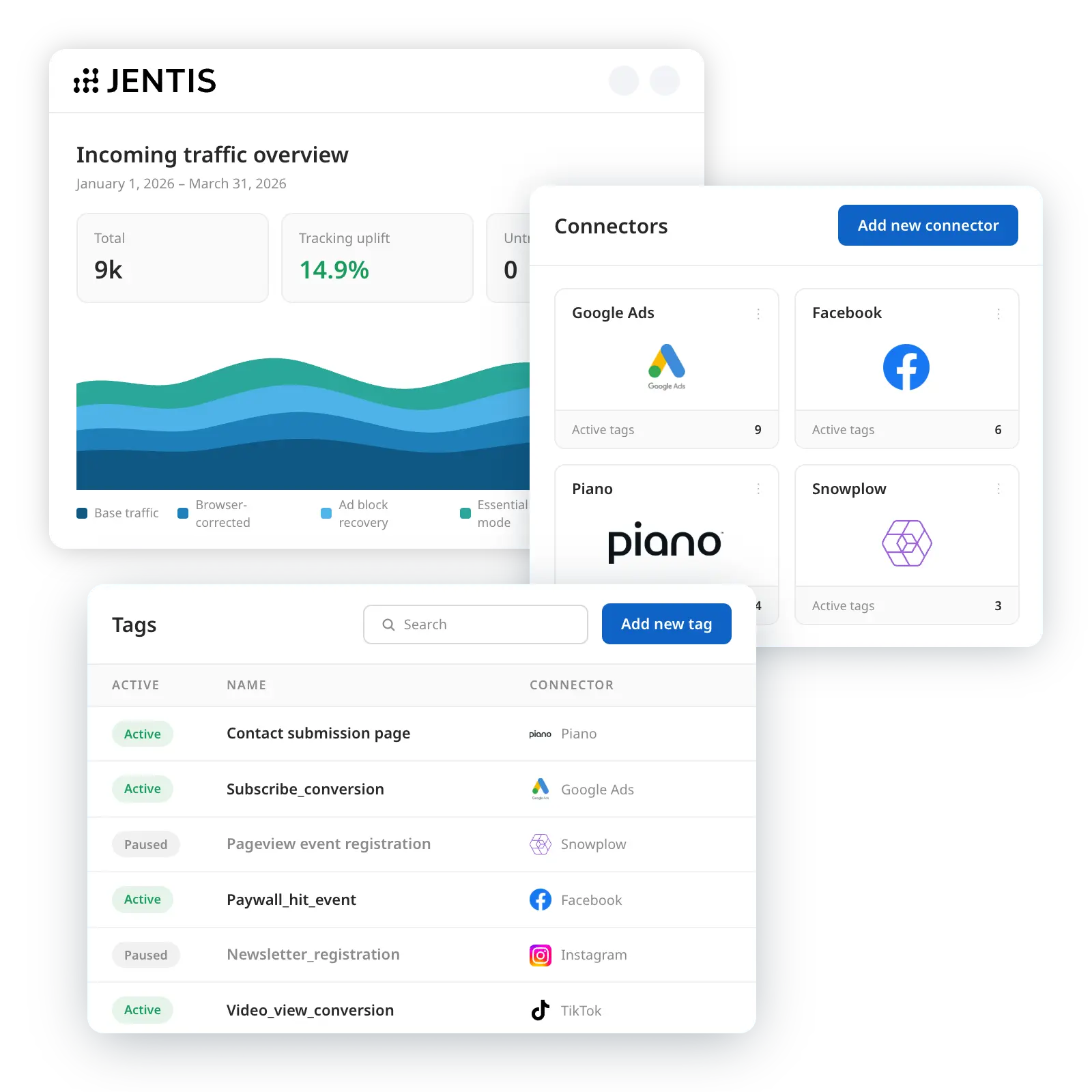
JENTIS is the single point of measurement in the browser. Every connected tool receives the same persistent ID and the same complete data.
Your analytics, ad platforms and marketing tools all work with JENTIS cookies instead of their own. One upgrade, whole stack.
How Cookie Lifetime Extender keeps cookies and IDs persistent.
Cookies are set server-side, on your domain.
A built-in check verifies your setup.
Consent decides when a cookie is set.
Broad compatibility with cloud infrastructure.
What customers say

format_quote
Choosing JENTIS was like moving from a standard solution to a premium one. With Synthetic Users, we saw that even the best industry practices can be outperformed by next-generation approaches, tracking 40 points more ROAS in only three weeks and achieving 94% data accuracy. It’s given us a far stronger foundation for data-driven decision-making, with the added benefit of working alongside a committed European partner.

Frequently asked questions
Lorem ipsum dolor sit amet, consectetur adipiscing elit. Suspendisse varius enim in eros elementum tristique. Duis cursus, mi quis viverra ornare, eros dolor interdum nulla, ut commodo diam libero vitae erat.
This is some headline text of an accordion
This is some headline text of an accordion
This is some headline text of an accordion
This is some headline text of an accordion
This is some headline text of an accordion
This is some headline text of an accordion
What are first-party cookies?
Why does Safari delete cookies after seven days?
Do ad blockers block JENTIS cookies?
Do connected tools receive JENTIS cookies?
What do I need to set up for persistent cookies?
Do JENTIS cookies work across subdomains?
How long do JENTIS cookies last?
Does JENTIS set cookies without consent?
Can JENTIS run without non-essential cookies?